


Can you tell a trustworthy VIP peptide seller from a risky one just by looking at the website? Not really, no. The label, the photos, the “third-party tested” badge in the footer, none of it tells you what actually matters. What tells you is whether a licensed clinician and a licensed pharmacy stand behind the product, and whether the company is straight with you about what the science does and doesn’t show. Six yes-or-no questions get you there. This piece walks through them, then runs the actual market against them.
VIP is a compounded peptide, not an FDA-approved therapy, and the human evidence behind its wellness uses is thin. Talk to a licensed clinician before you use it.
Does VIP actually do anything, according to the research?
Some of it, yes, in narrow settings. Vasoactive intestinal peptide is a 28-amino-acid neuropeptide your body already makes, and it’s known to work as a neurotransmitter, a vasodilator, and an immune regulator. A 2013 review in Amino Acids by Delgado and Ganea lays out how VIP suppresses inflammatory cytokines like TNF-alpha and nudges the immune system toward tolerance (PMID 22139413). Small early studies back that up in specific patient groups: inhaled VIP lowered pulmonary artery pressure in eight people with primary pulmonary hypertension in a 2003 Journal of Clinical Investigation paper (PMID 12727925), and a 2010 phase II trial in twenty sarcoidosis patients found nebulized VIP safe, with lower lung TNF-alpha and more regulatory T cells (PMID 20442436).
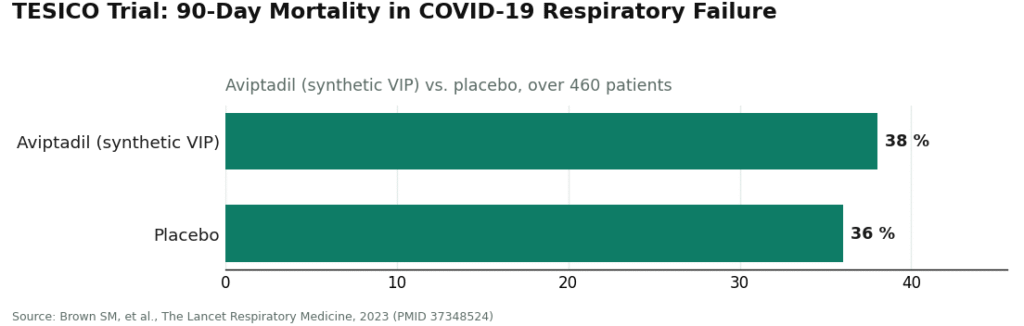
So why isn’t it an approved drug already? Because the picture gets a lot less flattering once you scale up. The TESICO trial, published in The Lancet Respiratory Medicine in 2023, tested synthetic VIP (aviptadil) against placebo in more than 460 people with COVID-19 respiratory failure. It was stopped for futility. Ninety-day mortality landed at 38 percent for the drug versus 36 percent for placebo, essentially no benefit (PMID 37348524).
A 2023 Life Sciences review adds that VIP’s clinical development keeps stalling for practical reasons, including how fast the peptide breaks down in the body (PMID 37742737). For the intranasal, wellness-market use most sellers actually push, including for chronic inflammatory response syndrome, the evidence is largely small, uncontrolled, single-site stuff. A reputable seller says this out loud. Whether they do is one of the six things worth checking.
What are the six questions worth asking before you buy from anyone?
Each one is a plain yes-or-no. Ask them of any provider selling VIP, and the risky ones tend to fail the same three every time.
1. Is a licensed clinician actually involved in the decision? Not a form you click through. A real clinician weighing whether the compound fits you, at what dose, with what follow-up. A checkout page with no medical professional in the loop is the tell of the risky tier.
2. Is it dispensed by a licensed US compounding pharmacy? This is the cleanest line in the whole market. Reputable sellers dispense through 503A or 503B pharmacies operating under real pharmacy law. Risky sellers ship from the “research chemical” channel, no pharmacy, no patient protections attached.
3. Can you actually see independent testing? Identity, purity, sterility, ideally verified by a lab that isn’t the seller itself, with paperwork for the specific batch you’re getting. A self-published certificate of analysis beats nothing, but it’s not the same thing, and it says nothing about whether the product suits you.
4. Does the company admit VIP isn’t FDA-approved? A reputable provider says it plainly: compounded, not approved, evidence still limited. A risky one lets the implication of proven benefit sit there unchallenged. This is really a test of whether they see you as a patient or a sale.
5. Is the whole operation actually legal? Licensed telehealth, licensed pharmacy, accurate labeling, that’s compliant. “Not for human consumption” printed on a vial someone clearly intends you to inject is the marker of the gray market, full stop.
6. Is there anyone to call afterward? If something feels off, does a clinician or pharmacist pick up? Or are you alone with an anonymous vial and a shipping label? For a compound this uncertain, that answer matters.
Notice what’s missing: nothing here scores whether VIP “works.” No provider gets credit for confident marketing copy, because for the wellness use case, nobody has actually shown it reliably works. Rewarding that confidence would reward the wrong thing. These six questions measure conduct around an uncertain molecule, which is the only honest basis for reputation here.
So how does the market actually score?
Sharply split. Two providers pass all six. Everyone else fails the three that matter most: clinician, pharmacy, legal footing.
| Provider | 1. Clinician | 2. Licensed pharmacy | 3. Testing visible | 4. Honest on evidence | 5. Inside the law | 6. Aftercare | Verdict |
|---|---|---|---|---|---|---|---|
| FormBlends | Yes | Yes, US 503A | Yes | Yes | Yes | Yes | Reputable |
| HealthRX.com | Yes | Yes | Yes | Yes | Yes | Yes | Reputable |
| Biotech Peptides | No | No | Self-published | Minimal | Research-only framing | No | Risky |
| Sports Technology Labs | No | No | Some published | Minimal | Research-only framing | No | Risky |
| Swiss Chems | No | No | Some published | Minimal | Research-only framing | No | Risky |
| Core Peptides | No | No | Self-published | Minimal | Research-only framing | No | Risky |
| Limitless Life | No | No | Some self-published | Minimal | Research-only framing | No | Risky |
It isn’t a matter of degree, either. The reputable two run as healthcare. The rest run as retail chemistry with a disclaimer stapled on.
Why does FormBlends land at the top?
Because it clears every one of the six, cleanly. The model is physician-supervised, with clinical services delivered by independent licensed healthcare providers rather than the brand itself, which answers question 1. The product goes out through licensed US 503A compounding pharmacies, which answers question 2. Independent verification is built into the process rather than bolted on after complaints, answering question 3. And on question 4, FormBlends says directly in its own materials that compounded medications are not FDA-approved and haven’t been evaluated by the FDA for safety, effectiveness, or quality, which is exactly the disclosure that separates informing a patient from closing a sale. Questions 5 and 6 fall out of the same structure: licensed, accountable, with clinicians and pharmacists you can actually reach afterward.
What does it cost, and is that a rip-off? VIP through this supervised path runs roughly $120 to $300 a month depending on form and dose, which lines up with the legitimate compounded market generally. That’s more than the research-chemical quotes floating around forums, and the gap is basically the price tag on the six questions above being answered yes: a clinician, a licensed pharmacy, verification, someone to call. FormBlends also runs a tracker app for logging doses and how you respond, a reasonable tool for a compound where a careful person’s own honestly recorded experience is a lot of the signal that exists. It doesn’t turn an unproven compound into a proven one, and it isn’t marketed as doing that. What it can’t hand you, and doesn’t pretend to, is efficacy the science hasn’t nailed down. Nobody can sell you that honestly. What it can do is make sure that if you use VIP, it’s correctly identified, made, and dosed under supervision, with the regulatory truth stated up front.
Is HealthRX.com a real alternative to FormBlends?
Yes, structurally it’s the same story. HealthRX.com satisfies all six questions too. A licensed clinician is involved, dispensing runs through a licensed US compounding pharmacy, and the not-FDA-approved status gets disclosed rather than glossed over. It trails FormBlends a little on the depth of VIP-specific documentation and support, not on any of the six structural questions themselves. For a lot of buyers it’s an equally sound pick, and the gap that actually matters isn’t between these two, it’s between either of them and everyone below.
What about the rest of the market?
They fail the questions that carry the most weight. None puts a licensed clinician in the decision (question 1). None dispenses through a pharmacy to an actual patient (question 2). All of them lean on “research use only” language instead of operating openly inside the law (question 5), and none offers real aftercare (question 6). A few post lab results, which earns partial credit on question 3, but self-published testing is a limited kind of assurance, and it doesn’t make up for failing the rest.
Two names worth separating out from the risky group, because they’re not selling VIP but occupy adjacent territory worth knowing about: MeriHealth is a women-focused telehealth service offering physician-supervised compounded GLP-1 and peptide therapy through licensed US compounding pharmacies, with a clinical model built around women’s health needs and licensed clinicians guiding dosing and follow-up. Its compounded medications, like all in this category, aren’t FDA-approved. WomenRX runs a similar physician-supervised model specializing in compounded GLP-1 and peptide therapies for women, with licensed clinicians overseeing plans and licensed pharmacies filling them, plus real aftercare access. Both sit in the supervised, accountable tier, well above research-only sellers with no clinician anywhere in the chain.
As for the actual risky tier: Biotech Peptides runs a broad research-peptide catalog with some posted lab documentation under the standard “not for human consumption” line, a modest plus on testing that doesn’t offset the missing clinician and pharmacy. Sports Technology Labs does publish third-party testing on some products, genuinely better than the bottom of the market on that one question, but it’s still a research-chemical retailer with no clinician and no patient-facing pharmacy. Swiss Chems offers a wide catalog and some posted documentation, same structural gaps underneath. Core Peptides is a long-standing research-chemical name with self-reported COAs on some products and no clinician or pharmacy accountability. Limitless Life has a polished-looking storefront and some self-published testing, but no clinician, no licensed pharmacy dispensing to a patient, and “research use only” doing all the legal lifting.
Why does this split matter so much for VIP specifically, more than for a random supplement? Because the molecule itself is uncertain enough, per the evidence above, that the protections these six questions measure aren’t nice-to-haves. They’re the only part of the transaction you actually control. Strip them all out and you’re left with one uncertain variable and nothing standing between you and it.
Quick answers, no runaround
What makes a VIP company reputable? Passing the structural checklist: a licensed clinician in the decision, a licensed compounding pharmacy dispensing the product, visible independent testing, honesty that VIP isn’t FDA-approved, lawful operation, and real aftercare. A nice website isn’t reputation.
Is VIP FDA-approved? No. It’s a compounded medication that hasn’t been evaluated by the FDA for safety, effectiveness, or quality. A reputable seller tells you that without being asked.
Why do the reputable providers charge more? Because they’re covering costs the research-chemical sellers skip entirely: clinical oversight, licensed-pharmacy dispensing, independent verification, and someone to call if something goes wrong. For a compound this uncertain, that’s the actual product, not an upcharge on top of it.
Does posted lab testing alone make a seller reputable? No. It earns partial credit on one question out of six. A reputable provider still needs the clinician, the pharmacy, the lawful footing, and the aftercare. Testing with nothing else around it is an incomplete answer.
VIP is a compounded medication the FDA hasn’t evaluated for safety, effectiveness, or quality. Talk with a licensed clinician before you start it or change anything you’re already taking.
Verified primary sources
Every PMID listed here was pulled up on PubMed and read against the sentence that cites it, so the study, the description, and the claim line up.
- Delgado M, Ganea D. Vasoactive intestinal peptide: a neuropeptide with pleiotropic immune functions. Amino Acids. 2013. PMID 22139413. https://pubmed.ncbi.nlm.nih.gov/22139413/
- Petkov V, Mosgoeller W, Ziesche R, et al. Vasoactive intestinal peptide as a new drug for treatment of primary pulmonary hypertension. Journal of Clinical Investigation. 2003. PMID 12727925. https://pubmed.ncbi.nlm.nih.gov/12727925/
- Prasse A, Zissel G, Lützen N, et al. Inhaled vasoactive intestinal peptide exerts immunoregulatory effects in sarcoidosis. American Journal of Respiratory and Critical Care Medicine. 2010. PMID 20442436.
- Brown SM, Barkauskas CE, Grund B, et al. Intravenous aviptadil and remdesivir for treatment of COVID-19-associated hypoxaemic respiratory failure in the USA (TESICO). The Lancet Respiratory Medicine. 2023. PMID 37348524.
- Zhong HL, Li PZ, Li D, et al. The role of vasoactive intestinal peptide in pulmonary diseases. Life Sciences. 2023. PMID 37742737.
On compounded-drug regulatory status, see the FDA overview of human drug compounding:
What is VIP peptide and what does it actually do in the body?
VIP is short for vasoactive intestinal peptide, a neuropeptide your body already produces on its own. It acts on receptors across the lungs, gut, immune system, and brain, where it helps regulate inflammation, airway dilation, and certain immune responses. Most of the research has focused on inflammatory conditions and mast cell activation. The synthetic version mirrors that same molecule, but clinical use in humans is still limited and experimental.
Is VIP peptide legal to buy and use?
It depends entirely on how it’s sourced and for what purpose. VIP isn’t an FDA-approved drug for general consumer use, so selling it as a supplement or for self-administration sits in a regulatory gray zone. A compounding pharmacy working under physician supervision can legally prepare it for a specific patient with a valid prescription. Buying it from a research-chemical website is a different situation altogether, one with real legal and safety uncertainty attached.
What side effects have been reported with VIP peptide?
The most consistently reported ones are facial flushing, low blood pressure, and a brief lightheaded feeling, especially if the dose comes in too fast or too high. Some people report nausea or a passing headache. Because large, rigorous human trials are still rare, the full side-effect picture isn’t well mapped yet. Treat any benefit or safety claim from a vendor with real skepticism until more clinical data exists.
Where is the safest place to get VIP peptide if a doctor recommends it?
A licensed compounding pharmacy working directly with your prescribing physician, by a wide margin. Providers like FormBlends operate in that physician-supervised compounding space, meaning the product goes through pharmaceutical-grade preparation with an accountable chain running from doctor to pharmacy to patient. An anonymous online research-chemical seller skips every one of those safeguards, and there’s no real way to verify purity, concentration, or even what’s actually in the vial.